Guideline/Manual

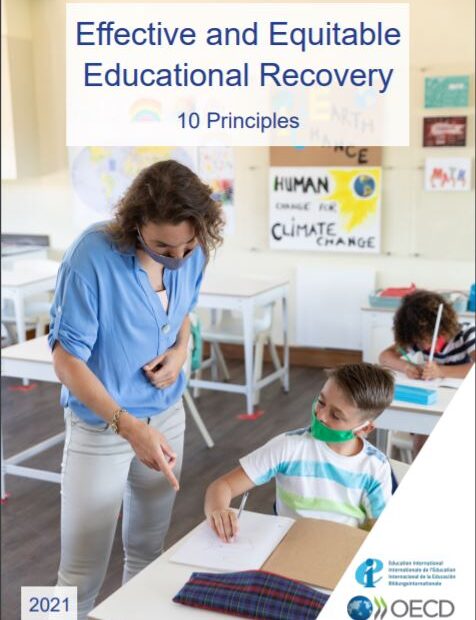
Effective and Equitable Educational Recovery - 10 principles OECD

Effective and Equitable Educational Recovery – 10 Principles

This document draws lessons from the pandemic and compiles policy experiences and practices from countries on diverse approaches to underpin a sustained educational recovery. This document presents 10 principles that can facilitate the collaboration of education authorities, the teaching profession
Screen Shot 2019-12-17 at 2.25.16 PM

Providing Services to Candidates with Special Needs

Candidates’ disabilities can roughly be categorised into physical, visual, aural, oral, specific learning disabilities (SLD) and others [e.g. Autistic Spectrum Disorder (ASD), Attention-Deficit / Hyperactivity Disorder (AD/HD), etc.]. Depending on the nature and severity of their disabilities, candidates are given

Screen Shot 2019-12-17 at 12.08.31 PM

Providing Services to Candidates with Specific Learning Disabilities

Specific Learning Disabilities (SLD) refers to severe problems in reading and writing (i.e. Dyslexia). The HKEAA has set up the Task Group on Special Examination Arrangements for Candidates with SLD to consider the applications from candidates with SLD. Members of

Screen Shot 2019-12-17 at 11.56.43 AM

Continuous and Comprehensive Evaluation Guidelines

All this paved the need for an effective model of CCE, which imbibes the ethos of child-friendly, learner-centred, inclusive and equitable teaching-learning and assessment. Although the efforts done at NCERT presented the same through resource material like Source Books on

Screen Shot 2019-12-17 at 11.49.37 AM

A Guide to Action Research

“A Guide to Action Research: Improving Professional Practice of Teachers in Bhutan” intends to assist teachers and school leaders in planning, and conducting action research projects to improve their instructional and educational management practices. Among other strategies, action research is

Screen Shot 2021-02-17 at 5.22.57 PM

Education system alignment for 21st century skills

Optimizing Assessment for All (OAA) is a project of the Center for Universal Education at the Brookings Institution. The aim of OAA is to support countries to improve the assessment, teaching, and learning of 21st century skills through increasing assessment

Screen Shot 2019-08-15 at 10.05.04

Citizen-Led Basic Learning Assessments for Children: An Innovative Approach

Citizen-led learning assessments offer an innovative approach to measure children’s learning. At present, such assessments are being implemented in India, Pakistan, Tanzania, Kenya, Uganda, Mali, Senegal, Mexico and soon Nigeria. This brochure, published by the newly established People’s Action for

Screen Shot 2019-08-16 at 13.44.19

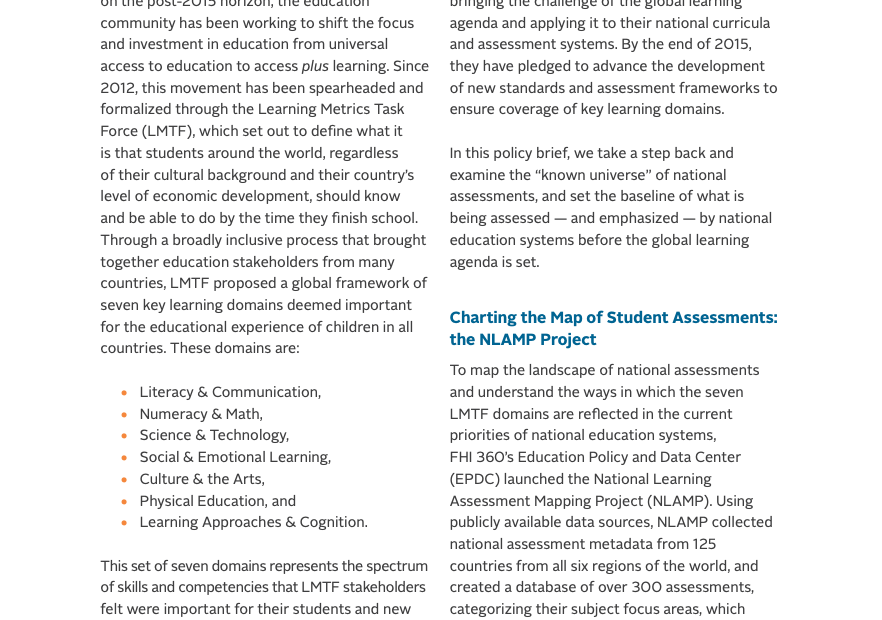
Mapping national assessments: EPDC Policy Brief

Prior to the World Education Forum held in May 2015, FHI 360’s Education Policy and Data Center (EPDC) undertook a mapping of the “known universe” of national assessments, looking at them vis-a-vis the seven learning domains proposed by the Learning

Screen Shot 2019-12-16 at 10.06.40 AM

Child Friendly Schools Manual

The Child-Friendly Schools Manual was developed during three-and-a-half years of continuous work, involving UNICEF education staff and specialists from partner agencies working on quality education.It benefits from fieldwork in 155 countries and territories, evaluations carried out by the Regional Offices

Screen Shot 2019-12-17 at 11.42.53 AM

Defining Quality in Education

During the past decade much has been done globally to provide quality basic education for children, an obligation for the Convention on the Rights of the Child. In reviewing the research literature related to quality in education, UNICEF takes a

Scroll to Top