South Asia

HQ issue note 4.3_COVID-19 education issue note on assessment and exams in May 2020

Managing High-Stakes Assessments and Exams During Crisis

This Issue Note highlights the coping strategies of countries in managing high-stakes exams during the COVID-19 crisis. To contain the spread of virus, many countries have shifted to online and distance learning and assessment modalities. Countries have adopted different strategies

Screen Shot 2019-08-16 at 11.25.50

A Conceptual Framework for Competencies Assessment

There can be no denying the influence of competencies on the development of the school and its curricula. The school and its stakeholders must therefore be tooled to be able to handle this novelty: conducting learning processes in terms of

Screen Shot 2019-08-16 at 11.19.02

Ten notes on systems for assessing learning processes

Juan Carlos Tedesco , a renowned and prestigious educator, shares his perspective on gauging and assessing learning. The author suggests that by taking a close look at the history of assessment and discussing the strengths and weaknesses often associated with

Screen Shot 2019-08-15 at 10.05.04

Citizen-Led Basic Learning Assessments for Children: An Innovative Approach

Citizen-led learning assessments offer an innovative approach to measure children’s learning. At present, such assessments are being implemented in India, Pakistan, Tanzania, Kenya, Uganda, Mali, Senegal, Mexico and soon Nigeria. This brochure, published by the newly established People’s Action for

Screen Shot 2019-08-16 at 13.44.19

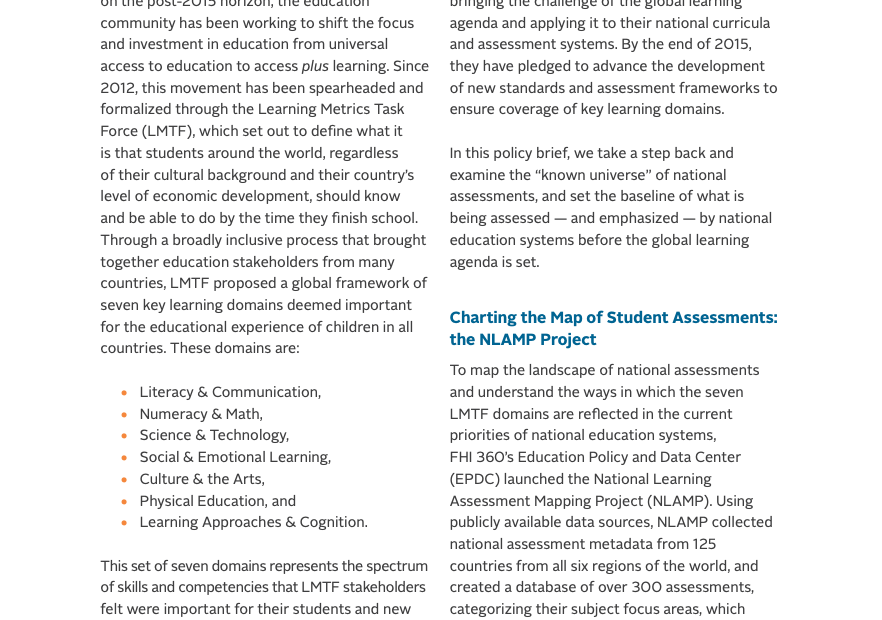
Mapping national assessments: EPDC Policy Brief

Prior to the World Education Forum held in May 2015, FHI 360’s Education Policy and Data Center (EPDC) undertook a mapping of the “known universe” of national assessments, looking at them vis-a-vis the seven learning domains proposed by the Learning

Screen Shot 2019-08-15 at 15.08.51

Family, Community, and Educational Outcomes in South Asia

This article reviews research on the economics and sociology of education to assess the relationships between family and community variables and children’s educational outcomes in South Asia. At the family level, the variables of family socioeconomic status (SES), parental education,

Scroll to Top