Latin America

HQ issue note 4.3_COVID-19 education issue note on assessment and exams in May 2020

Managing High-Stakes Assessments and Exams During Crisis

This Issue Note highlights the coping strategies of countries in managing high-stakes exams during the COVID-19 crisis. To contain the spread of virus, many countries have shifted to online and distance learning and assessment modalities. Countries have adopted different strategies

Screen Shot 2019-08-16 at 10.38.48

How does PISA for Development measure scientific literacy?

PISA defines scientific literacy as the ability to engage with science-related issues, and with the ideas of science, as a reflective citizen. It emphasises the importance of being able to apply scientific knowledge in the context of real-life situations. The

Screen Shot 2019-08-16 at 11.25.50

A Conceptual Framework for Competencies Assessment

There can be no denying the influence of competencies on the development of the school and its curricula. The school and its stakeholders must therefore be tooled to be able to handle this novelty: conducting learning processes in terms of

Screen Shot 2019-08-16 at 11.19.02

Ten notes on systems for assessing learning processes

Juan Carlos Tedesco , a renowned and prestigious educator, shares his perspective on gauging and assessing learning. The author suggests that by taking a close look at the history of assessment and discussing the strengths and weaknesses often associated with

Screen Shot 2019-08-16 at 13.44.19

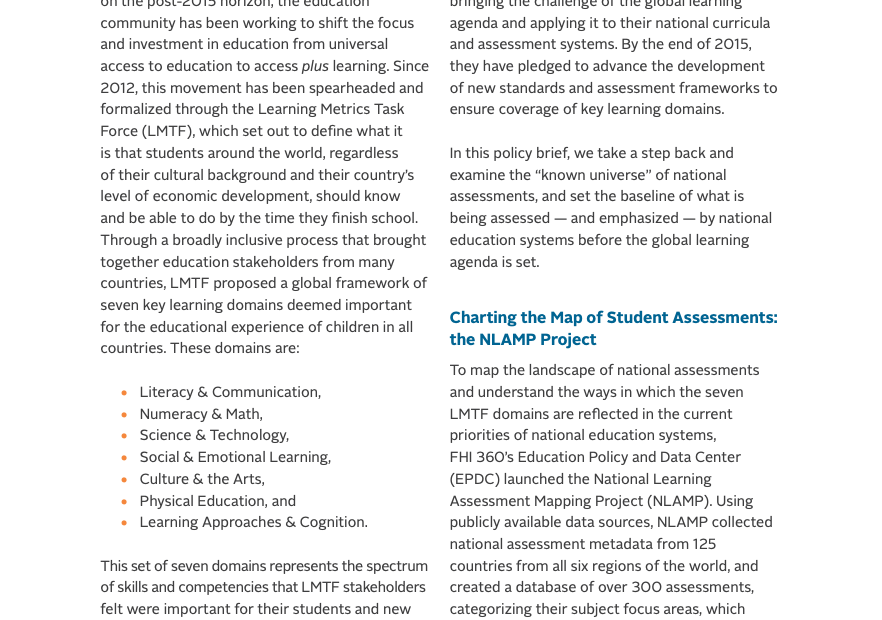
Mapping national assessments: EPDC Policy Brief

Prior to the World Education Forum held in May 2015, FHI 360’s Education Policy and Data Center (EPDC) undertook a mapping of the “known universe” of national assessments, looking at them vis-a-vis the seven learning domains proposed by the Learning

Screen Shot 2019-08-15 at 10.54.32

PISA 2012 Technical Report

The OECD Programme for International Student Assessment (PISA) surveys, which take place every three years, have been designed to collect information about 15-year-old students in participating countries. It is now recognised that the future economic and social well-being of countries

Scroll to Top