
NEQMAP Steering Group convenes
The Network on Education Quality Monitoring in the Asia-Pacific (NEQMAP) was launched on 28 March 2013 as a new regional platform to improve the quality of learning in the Asia-Pacific region by enhancing the use of student learning assessment to strengthen education systems.
NEQMAP serves as a mechanism for the exchange of expertise, experience and lessons to improve the quality of learning in the education systems of the Asia-Pacific region, with the eventual aim of influencing policy reforms. Such a platform has not previously existed in the region, despite a strong culture of public examinations in education systems as well as participation in international comparative assessments such as PISA and TIMSS.
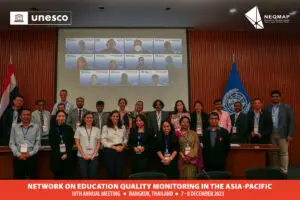
At present, NEQMAP counts 16 members across 12 countries and jurisdictions in the region. The five Steering Group members represent the various sub-regions of the Asia-Pacific and are recognized experts in the area of monitoring educational quality. In keeping with their role of providing advice on the planning of the network’s activities, an initial Steering Group meeting was held in Bangkok on 20 September.
During the meeting, the NEQMAP Secretariat at UNESCO Bangkok provided the Steering Group members with an update in regard to institutional and membership matters, communications and publicity and resource mobilization efforts. In addition, the network’s engagement with some of the major current international initiatives on student learning assessment was discussed, including the PISA for Development initiative being led by the OECD and the Learning Metrics Task Force, which recently launched a summary report of its global recommendations.
The Steering Group members undertook some key decisions in regard to all of these areas and also discussed the likely priority activities of NEQMAP over the next several months. These include the following:
• Establishment of a knowledge base on student learning assessment in the region, including policies, national frameworks, tools and examples of test instruments and questionnaires
• Regional mapping study on existing policies and instruments for measuring/monitoring learning outcomes
• Regional/comparative research study on how the results of learning assessments are used and their impact on policy and practice
• Regional/comparative research study on assessment of transversal or 21st century skills
• Organization of a regional capacity building workshop on issues and experiences in assessment in the Asia-Pacific region focused on overall assessment literacy
Institutions in the Asia-Pacific region with an interest in these activities and the overall mandate of NEQMAP are encouraged to apply for membership in the network. In so doing, they can join an active community of experts and practitioners with rich and diverse experience in regard to student learning assessment, which is increasingly being recognized as crucial aspect of enhancing the of quality in education.
For more information, please contact Ramya Vivekanandan [r.vivekanandan(at)unesco.org] at the Education Policy and Reform Unit.
Written by Ramya Vivekanandan [r.vivekanandan(at)unesco.org]