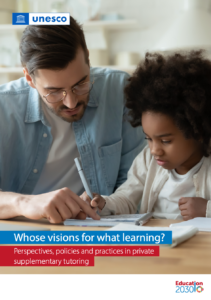
The paper examines private supplementary tutoring (“shadow education”) as a worldwide phenomenon that has grown rapidly, with the market estimated at US$159 billion in 2023 and projected to US$288 billion by 2030. It describes the many forms tutoring takes—one-to-one, small groups, large classes, and increasingly online/AI—while noting that reliable data are scarce: in a 2021 UNESCO request to 205 jurisdictions, nearly 70% could not provide statistics. Snapshot figures underline the scale (e.g., Egypt Grade 12: 72% in one-to-one tutoring; Greece Grade 12: 70% attend tutorial institutions; Chile Grade 8: 23% in maths tutoring).  Policy responses vary: some governments (e.g., China, Egypt) have acted, while many remain laissez-faire, prompting a call to regulate early rather than ignore the sector. The report also highlights rights and equity tensions, using Republic of Korea experience to show bans can drive tutoring underground and that the practice persists even in high-performing systems—hence the need for informed, balanced regulation.
Author(s): Mark Bray, UNESCO
Year Published: 2025
Language: English
Country: Global / multi-country
Download: https://neqmap.bangkok.unesco.org/wp-content/uploads/2025/10/394619eng.pdf