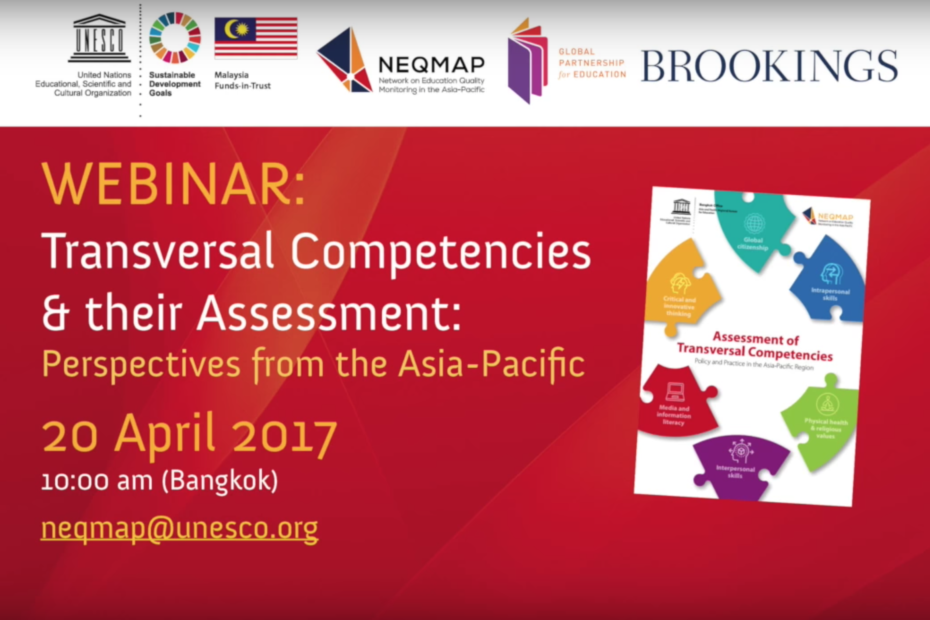
Transversal Competencies & their Assessment: Perspectives from Asia-Pacific – NEQMAP Webinar
Webinar held 20 April 2017, hosted at 10am from Bangkok, Thailand Organized by the NEQMAP Secretariat at UNESCO BACKGROUND: Our ever-changing world requires learners to be equipped with the knowledge and skills to cope with constant social and economic change,

What do we know about teachers’ selection and professional development in high-performing countries?
High-performing countries use various mechanisms to select the best candidates to the teaching profession. In Finland, Hong-Kong (China), Macao (China) and Chinese Taipei, students who wish to enter teacher-training programmes must pass a competitive entry examination. In Japan, teaching graduates

How does PISA for Development measure scientific literacy?
PISA defines scientific literacy as the ability to engage with science-related issues, and with the ideas of science, as a reflective citizen. It emphasises the importance of being able to apply scientific knowledge in the context of real-life situations. The
National Education Strategic Plan 2016-2021 Summary
The Ministry of Education in Myanmar has undertaken a three-and-a-half-year Comprehensive Education Sector Review (CESR) involving three phases: a rapid assessment (Phase 1); in-depth research and analysis of critical sub-sector challenges (Phase 2); and drafting and building ownership for an
How to Ensure Universal Learning?
Findings and experiences from Asia-Pacific. Friday, 13 May 2016 Ramya Vivekanandan, UNESCO Alfonso Echazarra, OECD Dr. Haewon Lee, KICE

Assessment of transversal competencies: policy and practice in the Asia-Pacific region
This report draws on reports from nine participating countries/jurisdictions in the Asia-Pacific: Australia, Hong Kong (China), India, Malaysia, Mongolia, Philippines, Republic of Korea, Thailand and Viet Nam. These in turn drew upon responses from individuals in their education systems at

Measures that Matter: Learning Outcome Targets for Sustainable Development Goal 4 – An examination of national, regional and international learning assessments
This paper assesses the merits of different learning assessments for measuring progress toward the Sustainable Development Goal (SDG) for education and its associated targets, as adopted by the international community in Incheon, Republic of Korea during the World Education Forum
A Conceptual Framework for Competencies Assessment
There can be no denying the influence of competencies on the development of the school and its curricula. The school and its stakeholders must therefore be tooled to be able to handle this novelty: conducting learning processes in terms of

Study on the Factors Affecting Scholastic Achievement (A Case of Mandalay Region)
A study on the Factors Affecting Scholastic Achievement of Grade 5 and Grade 9 in February 2015 was conducted using the data in Chin State. According to the analysis, it was found that educational conditions such as “student/teacher ratio,” “quality
Ten notes on systems for assessing learning processes
Juan Carlos Tedesco , a renowned and prestigious educator, shares his perspective on gauging and assessing learning. The author suggests that by taking a close look at the history of assessment and discussing the strengths and weaknesses often associated with
Study on the Transition from School to Society
A structure of the educational background of people, who transfer as graduates or dropouts from different level of schools in society within a year, can be estimated using the cumulative transition rates in specific years. These people can become the
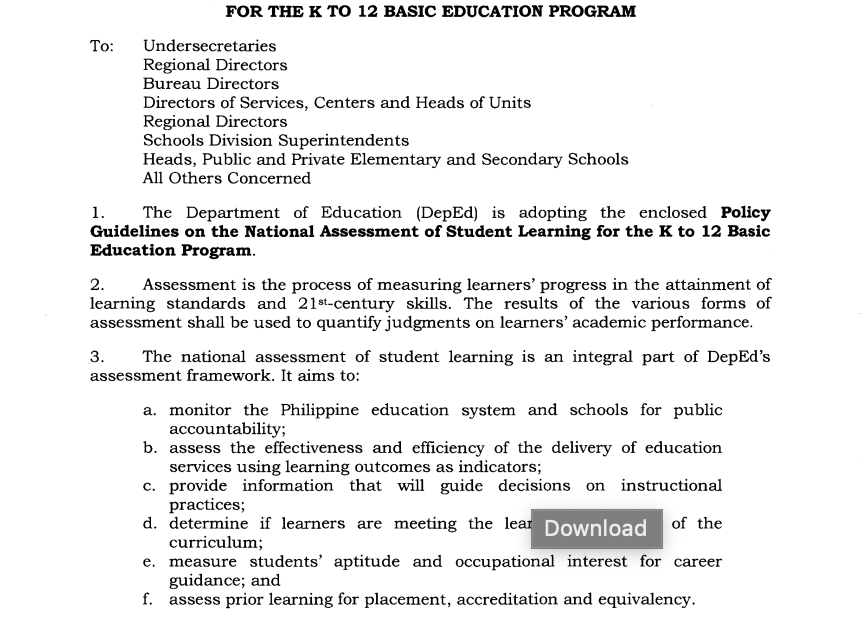
Policy Guidelines on the National Assessment of Student Learning for the K to 12 Basic Education Program
1. The Department of Education (DepEd) is adopting the enclosed Policy Guidelines on the National Assessment of Student Learning for the K to 12 Basic Education Program. 2. Assessment is the process of measuring learners’ progress in the attainment of
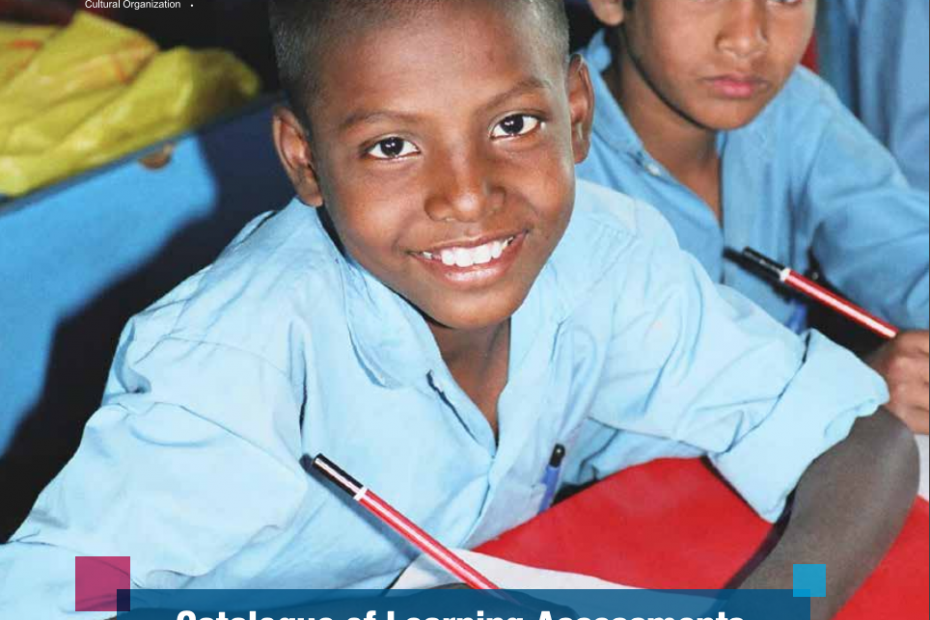
Catalogue of Learning Assessments: A public resource to learning assessments around the world
The UNESCO Institute for Statistics (UIS) has created the Catalogue of Learning Assessments to provide standardised, comparable information about learning assessments administered in primary and lower secondary education programmes in countries across the world. For each assessment, the Catalogue provides
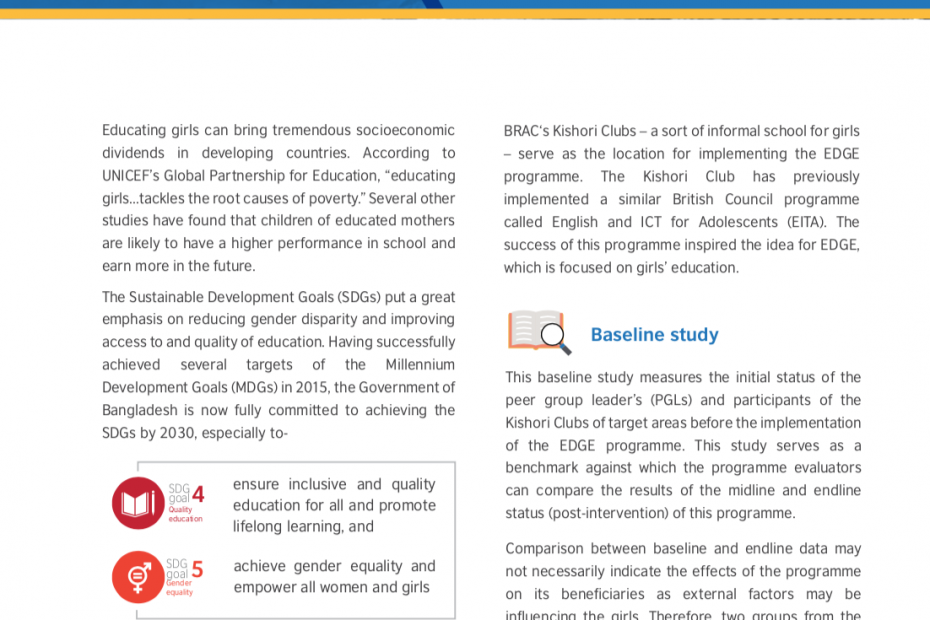
Baseline study on English and Digital for Girls’ Education
This baseline study measures the initial status of the peer group leader’s (PGLs) and participants of the Kishori Clubs of target areas before the implementation of the EDGE programme. This study serves as a benchmark against which the programme evaluators